
Members and partners from across the Surrey Hills came together this October for the annual Surrey Hills National Landscape Partnership Tour, with this year’s event focusing heavily on water resource management in the Leith Hill and Dorking area. We would like to extend our sincere thanks to everyone who attended, and to the hosts who generously shared their time, knowledge and projects with us.
Water was a recurring theme throughout the day, influencing discussions at every stop and highlighting its vital role in shaping the health, resilience and future of the Surrey Hills National Landscape. From natural flood management and river restoration to farming, biodiversity and climate resilience, the tour showcased how collaboration is helping to address shared challenges and deliver benefits for both people and nature.
The day offered a valuable opportunity to see partnership working in action, hear directly from those managing the land, and explore how organisations, communities and businesses can work together to achieve more.
Highlights included:
- Discovering how nature-based solutions can help slow the flow of water and reduce flood risk.
- Learning about projects that are improving habitats and water quality while supporting wildlife recovery.
- Hearing how farmers, landowners and environmental organisations are working together to build landscape resilience.
- Exploring opportunities for future collaboration across the Surrey Hills National Landscape.
Whether you joined us on the day or were unable to attend, we hope the highlights below provide a flavour of the inspiring projects, partnerships and conversations that are helping to shape the future of our National Landscape.
Click on each section below to find out more about the sites visited and the people behind them.
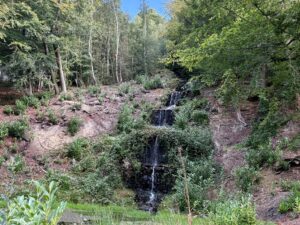
Tillingbourne Waterfall Restoration Wotton Estate – Surrey Hills National Landscape
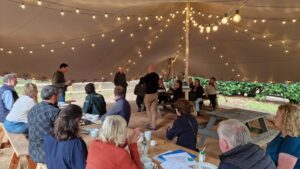
We discussed the importance of supporting low cost accommodation in the National Landscape, the need to innovate and diversify.
The Hideout is now a hub for mountain biking which is a key management issue, and hosts three new eco-pods to improve access. Revenue will be invested back into conservation and access.
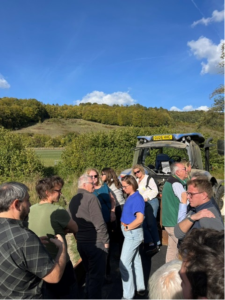
Mark Lebus of LC Energy talked about Biochar, a carbon-rich, fine-grained, charcoal-like substance, being trialled in the Surrey Hills National Landscape to reduce pollution and improve soil condition.
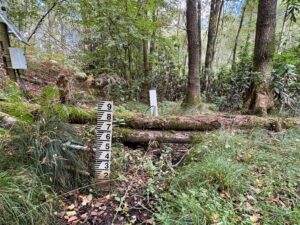
The visit continued on a trailer ride around the farm focusing on conservation work, including the herbal lays and the wildlife margins. Owen Lee of Surrey County Council’s Flood Team outlined a project to clear trees and create dams to slow the flow along the Pippbrook.
Adam Brown, Surrey Local Nature Recovery Strategy Manager, outlined the ambition to restore chalk downland through grazing along across the scarp of the North Downs through the Big Chalk Nature Recovery Fund.