These illustrations are by an artist taking part in a programme delivered by Watts Gallery Trust and funded by the Michael Varah Memorial Fund. This series of 30 Surrey Hills Indicator Species were commissioned by Surrey Hills Society and funded by Surrey Hills Trust Fund as part of the Making Space for Nature Exhibition.
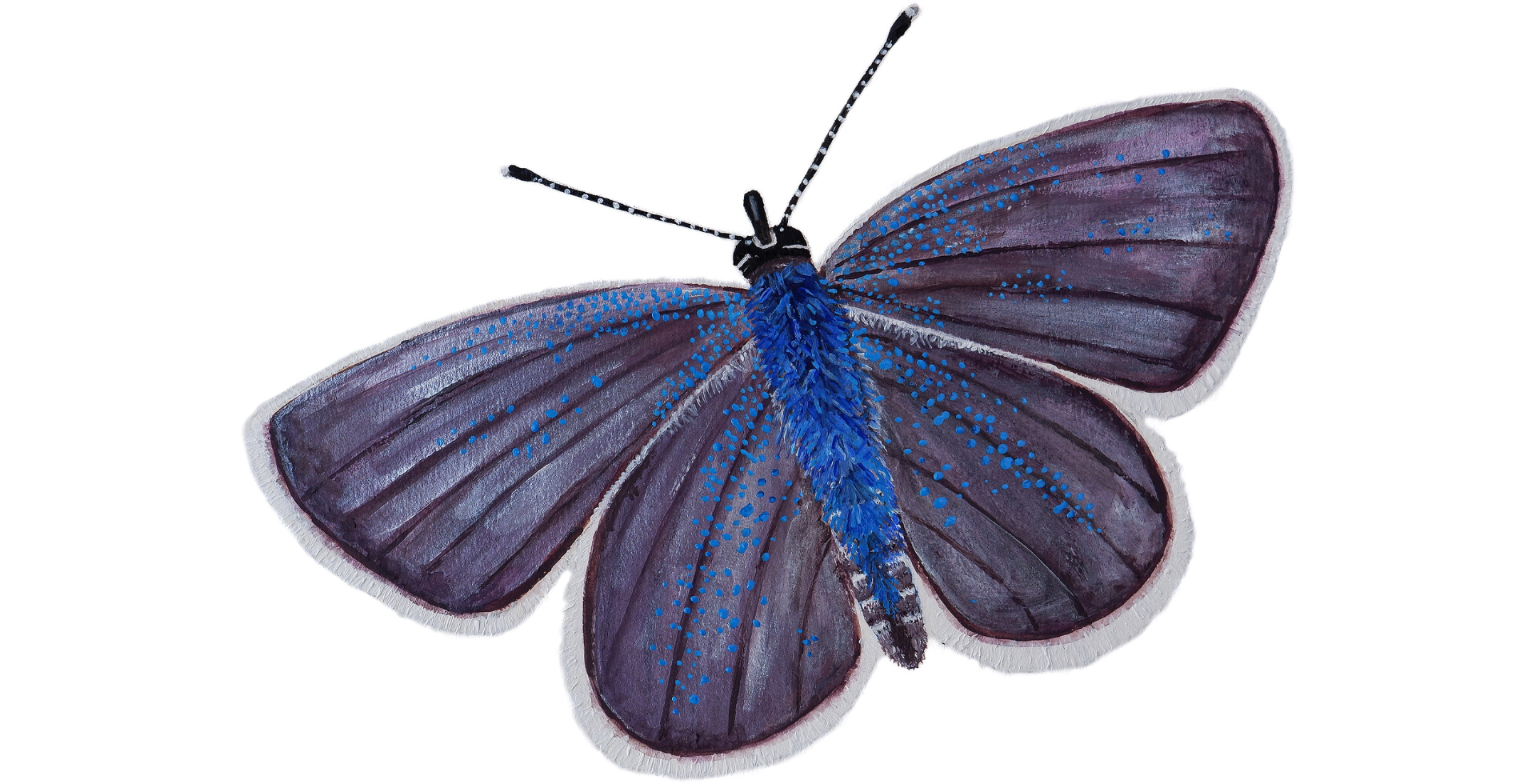
Small Blue
What is the Small Blue?
The small blue is our smallest British butterfly and isย an indicator of chalk grassland in good condition.ย Itโs wings are brown, fringed with white, with a fine layer of blue scales spreading out from the body. The undersides of the wings are grey with dark spots and a slight blue colour again spreading out from the body.ย Theย adults fly between mid-May and early July and there may be a second generation inย high summer.ย The caterpillar foodplant is kidney vetch.
Why is the Small Blue important to the Surrey Hills?
The small blue is protected under the Wildlife and Countryside Actย (1981)ย and is a UK Priority Species for conservation.ย It is a rare butterfly found mainly in south-central England though it can also be found along some eastern Scottish coasts and both the east and west coast of Ireland.ย It is very localised in distribution and its range has declined byย 44% since theย 1970s.
What habitat does the Small Blueย like?
Chalk Grassland
Chalk grasslandย (or lowland calcareous grassland)ย is aย habitat of international importance forย bothย its rarity andย itsย species richness.ย Itย is found over limestone and chalk rocks and grows below an altitude of 250 metres on shallow, lime-rich soils, mainly in the warmer, drier south and east of the UK.ย As many asย 40ย differentย plantย speciesย can be foundย within a square metre. Many ofย themย are so specialised that theyย can be foundย onlyย in chalk grasslandย whereย they are specially adapted to theย thin,ย infertileย but base-richย soils.ย Characteristic featuresย of the habitatย often include ant-hills and, on steep slopes,ย terracettesย or sheep walks.ย Small patches of scrub add to the habitat diversity by providingย bird-nesting habitat and song-posts.
The UK holdsย aroundย 50% of the worldโs surviving chalk grasslandย with major concentrations on the North and South Downsย of south-east England.ย Formerly widespread in these areas,ย an estimated 80%ย had disappearedย by WWIIย andย only 1% of the Surrey Hills has remnant chalk grassland cover.
How to support the Small Blue
Good management for this species will create/result in:
- Chalk grassland with a high diversity of wildflowers andย their associated insects
This will benefit a wide range of other specialist chalk grassland plants including otherย vetches such as horseshoe vetch, orchids such as bee orchid and pyramidal orchid, wild marjoram, dropwort, small scabious and many others. It will also benefit their associated insects such asย otherย blue butterflies.
Opportunities to create/improve/extend suitable habitat for this species include:
- Grazing by hardy livestock breeds to control scrub and dominant grasses
- Clearing scrub and controlling its regrowth
- Controlling invasive species such as tor grass, stinging nettle, creeping thistle and common ragwort
- Protection from nutrient enrichmentย byย fertilisation or agricultural spray drift
Creating and managing areas for the Small Blue will help deliver the following benefits to communities:
- Clean water
- Clean air
- Protection from and mitigation of environmental hazards
- Mitigation of and adaptation to climate change
- Thriving plants and wildlife
- Beauty, heritage and engagement
Current conservation projects
Surrey Hills Society has been facilitating several volunteer groups (including Surrey Choices Growth Team, Halow, Defra and Butterfly Conservation) to help with the restoration of chalk downland at the Hampton Estate, Puttenham. This involves removing inappropriate tree species (such as Hawthorn) from the chalk downland using tree poppers. Once this work has been completed, Butterfly Conservation are planning to plant kidney vetch, the foodplant of the Small Blue butterfly caterpillar. It is hoped that this will help to bolster the population of Small Blue butterflies and contributes to a wider restoration project taking place along the North Downs, which is being coordinated by Butterfly Conservation. Enhancement of chalk downland habitat will also help to benefit a whole range of other butterfly and pollinator species.
