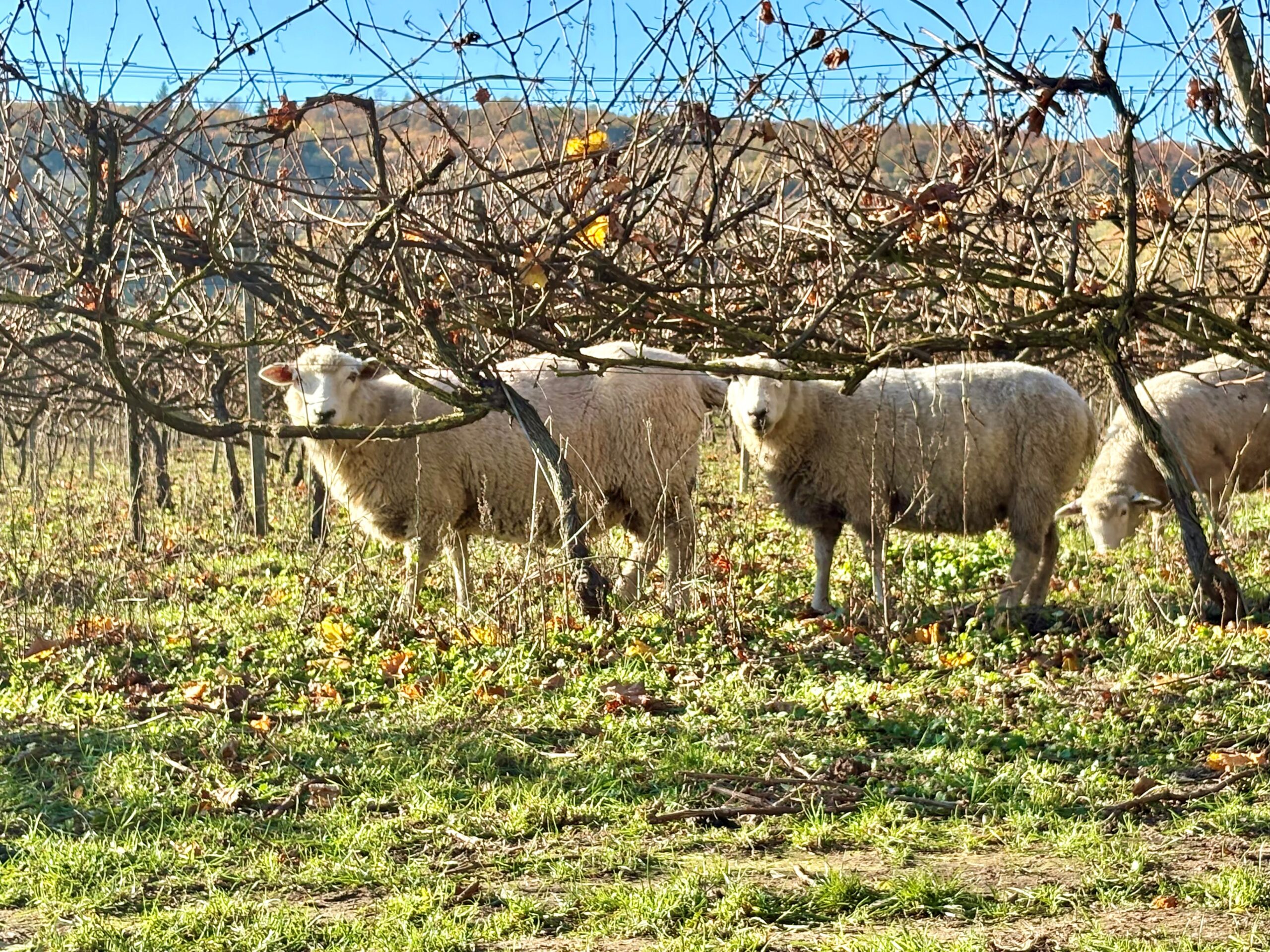
Two sheep (side view) looking at the camera. They are standing between the vines with a blue sky above.

Surrey Hills and South East Fibreshed Launch Project to Explore the Future of Local Wool

A new project in the Surrey Hills National Landscape is set to explore how greater value can be created from locally produced wool, helping to support nature-friendly farming and the landscapes it helps maintain.

The Surrey Hills Cloth Research & Development Project, funded through Defra’s Farming in Protected Landscapes (FiPL) programme in partnership with the South East England Fibreshed, will investigate whether wool from native Romney sheep grazing the Surrey Hills can provide new opportunities for farmers, while celebrating the area’s farming heritage and natural assets.

Nick Bullen, Local Farmer and British Wool Board (Surrey Representative), said:

“For many sheep farmers, wool no longer provides the value it once did. This project gives us an opportunity to explore new ways of recognising the quality and provenance of the wool produced by sheep grazing the Surrey Hills, and to rediscover what wool can offer in the modern age. If it works for Romney, it will provide a template for any native breed in the Surrey Hills. I am looking forward to seeing how wool, a historic fibre with a long association with Surrey, can be brought back into popular use through contemporary design and production techniques.”

The project will explore the journey from farm to yarn, examining how wool quality, processing and provenance could help create new opportunities for British wool produced in the Surrey Hills and the farming businesses behind it.  Romney sheep play an important role in grazing habitats across the Surrey Hills. This traditional management helps maintain landscapes such as chalk grassland, supporting biodiversity and the distinctive character of the National Landscape.

Working with the South East England Fibreshed network and industry specialists, the project will follow the wool supply chain from fleece through processing and textile development, identifying opportunities, challenges and practical lessons that could benefit farmers, makers and producers across the region. The findings will also consider how stronger markets for local wool could help sustain conservation grazing as a long-term tool for landscape management.

Deborah Barker, co-founder South East England Fibreshed said:

“South East England Fibreshed is delighted to be part of this innovative project. Working with local fibres in ways that support farming, and restore and maintain landscapes, is central to our ethos. Drawing on our network we have brought together a team of experienced designers who believe local native breed wool belongs at the heart of fashion and interiors once again. We are excited to see what they create, and what we can learn from this project to support wider use of Surrey Hills fleece.”

Sarah Thiele, Programme Manager, Surrey Hills National Landscape, said:

“The landscapes people enjoy across the Surrey Hills don’t manage themselves. They depend on the farmers, livestock and traditional practices that help shape them. This project will explore whether creating greater value from locally produced wool can help support nature-friendly farming while reconnecting people with the story behind one of Britain’s most sustainable natural fibres.”

Throughout the project, Surrey Hills National Landscape will share updates from the research, including stories from farmers, insights into British wool production and the journey from fleece to fabric.  As the project develops, findings will help inform future discussions around sustainable rural enterprise, local provenance and the role of natural fibres in supporting resilient farming systems.
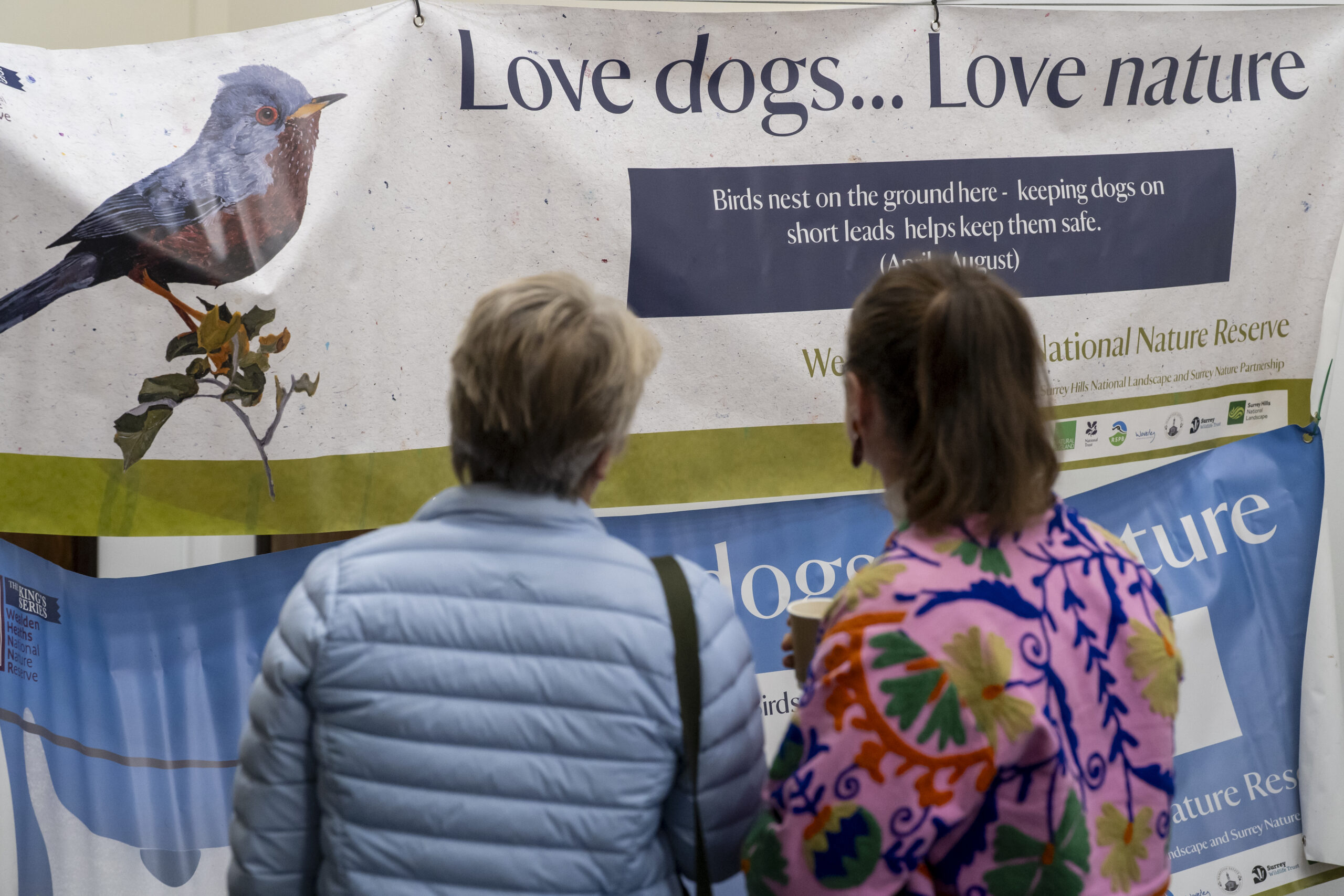
 

Two people (one wearing a blue coat and the other a multi colour jacket) looking at a banner. The banner has a bird and 'Love Dogs, Love Nature' slogan on it.

Love Dogs, Love Nature Brings Together Voices from Across Surrey (and Australia!)

This week, people came together at Denbies Wine Estate for Love Dogs, Love Nature: Rethinking the Future of Dog Walking in the Surrey Hills, a special event held as part of the ESRC Festival of Social Science 2026.

With dog ownership having nearly doubled since 2011, understanding how people, dogs and wildlife can thrive together has never been more important. Research commissioned through the Love Dogs, Love Nature project is helping to shape practical approaches that support nature recovery, responsible access and working landscapes across the Surrey Hills National Landscape.

Researchers, conservationists, farmers, land managers and dog owners came together to share insights on the benefits of dog walking, its impact on wildlife and livestock, and the opportunities to encourage responsible countryside access. 

A particular highlight was hearing from Dr Jasmin Packer of the University of Adelaide, whose Australian perspective showed that many of the challenges facing the Surrey Hills are shared across the world, and that there is much to learn from different landscapes and experiences.

Above all, the event highlighted the value of partnership working. By bringing together research, practical experience and local knowledge, we can build a better understanding of these complex issues and explore solutions that work for people, dogs and nature.

The event was delivered in partnership with the University of Surrey and Surrey Nature Partnership as part of the wider Love Dogs, Love Nature initiative. Find out more by reading the Love Dogs, Love Nature project report , which was funded by the Surrey Hills National Landscape and published by the Institute for Sustainability, University of Surrey, the Surrey Hills National Landscape and the Surrey Nature Partnership.

Follow us on social media to keep up to date on our projects.

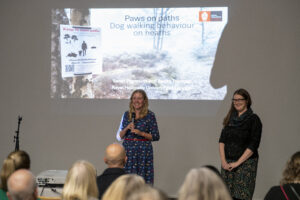
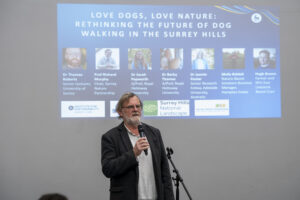
A man in a dark jacket and white shirt holding a microphone, in front of a slide projected onto a wall.  Slide says 'love dogs, love nature' Two people (one holding a microphone) in front of a slide projected onto a wall.  Slide says 'paws on paths'

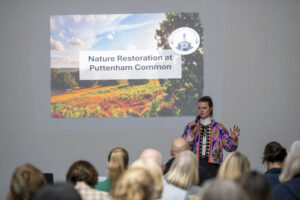
One person holding a microphone in front of a slide projected onto a wall.  Slide says 'Nature Restoration at Puttenham Common'

New research shows spending time in nature has positive health benefits

A new study conducted by the Forest Bathing Institute and the University of Derby has shown positive health benefits from spending time in natural woodland. They have also shared their mindfulness tips to maximise your time in nature.

Forest Bathing, also known as ‘Shinrin-yoku’ is a mindful walk in woodland, under the canopy of the trees. In Japan and South Korea, it is a well-known public health intervention and is used to treat high blood pressure and stress.

But can it be effective in the UK, where we have different cultural values, lifestyle habits and vastly less tree cover – 11% compared with Japan’s 70%.

During 2019, The Forest Bathing Institute partnered with Dr Kirsten McEwan at the University of Derby to conduct the first ever UK scientific research study into the physiological benefits of Forest Bathing+, this ground-breaking study revealed incredibly positive results.

After 2 hours of Forest Bathing+ 88% of participants reported an average 29% reduction in anxiety. What was really striking was that 57% of participants showed an increase in their Heart Rate Variability (HRV). HRV is an indicator of having a good balance in the nervous system and indicates that the body is in its ‘rest and recuperative state’ or ‘parasympathetic system’ indicating good cardiovascular health.


Positive Impact of time spent under tree canopy

Summary from The Forest Bathing Institute and the University of Derby pilot UK Forest Bathing Study conducted in 2019.

The graph reveals which Forest Bathing+ sensory exercises led to the greatest increase in HRV, such as lying down under the tree canopy and being guided in sensory mindfulness, listening to the sound of running water, smelling the forest air, the mosses, lichens and leaf-litter and spending time quietly with a tree. Sharing experiences with each other as a group was also significant. For anyone wishing to maximise their Forest Bathing+ experience, these are the exercises to focus on.

So, is there a ‘correct dose’ that people should be aiming for to optimise the benefits of Forest Bathing+?

Dr Kirsten McEwan, Senior Lead Researcher from the University of Derby said; ‘Previous studies have shown that benefits (such as a boosted immune system) can last for up to one month. Our study found that by three months, some of the benefits people had reported following their Forest Bathing+ session had dwindled.

Dr McEwan continued; ‘This suggests that regular practice is needed, indeed in Japan, Dr Qing Li recommends that Forest Bathing is practised for two hours every two weeks. Depending on the quality of the woodland environment, this should provide a constant boost to the immune system.’

Gary Evans, Co-Founder Director of The Forest Bathing Institute said; ‘We encourage everyone to spend as much time as they can in nature, whether that be going for a daily walk in their local park or woodland area. We tend to suggest that people spend whatever time is available to them within their normal routine, and then perhaps extend this as their schedule allows, as they realise how much they are actually enjoying it! We have found that many people are surprised at how much better they feel after only a short period of time! That is the impact that nature has on many of us.’

Top Mindfulness Tips to maximise your time in Nature

– Slow down and breathe in the wonderful forest air, taking time to notice your surroundings.

– Notice the different types of colour green within your line of vision. Is there a colour that stands out?

– Observe the colour of any buds beginning to blossom on the trees, and flowers beginning to bloom.

– Notice the different patterns of bark on the trees around you, touch the tree, trace your fingertips on the bark, what does it feel like? Is it smooth, coarse, prickly, warm, or cold?

– Tune into the birdsong or the sound of the insects and bees at play, as they dart around pollinating any newly opened buds and flowers.

– Smell the scent of the earth and leaf litter on the forest floor, the lichens or moss around you.

– And finally, you might just want to sit under a tree and quietly contemplate, letting thoughts drift in and out.

– All of these sensory activities help your mind and body to relax and to re-charge.

If this sounds like an experience you would love to explore for yourself, then do book onto one of the Forest Bathing+ nature therapy sessions. We look forward to meeting you in one of our wonderful, woodland environments very soon.

New Career Direction?

Do you love spending time outside in nature? If you are exploring a new career direction, you might like to find out more about training to become a Forest Bathing+ Guide. We work with many of the major landowners across the UK and are currently training people to join our ever-expanding team. You can find out more about what is involved here and also listen first hand to what our Forest Bathin